How to Get Honest Customer Feedback in Nigeria Without Spending Millions on Market Research
Discover affordable ways to collect honest customer feedback in Nigeria, understand your customers, and make smarter business decisions.
What if the insights your business needs to grow are already in the minds of your customers, but you’re simply not asking the right questions?
Every day, Nigerian businesses make decisions about products, pricing, marketing, and customer experience. Some of these decisions lead to impressive growth. Others result in wasted resources, disappointing sales, and products that struggle to gain traction.
Often, the difference comes down to one thing: how well a business understands its customers.
For many startups and small businesses in Nigeria, conducting market research sounds expensive, complicated, and time-consuming.
But here’s the good news: understanding your customers doesn’t necessarily require a multimillion-naira research budget.
With the right approach, even a small business can collect meaningful customer feedback, identify opportunities, and make better-informed decisions
Here’s how.
Understand Why Customer Feedback Matters
Imagine spending months developing a product, investing heavily in marketing, and finally launching it, only to discover that customers aren’t particularly interested.
It’s a frustrating situation, but one that businesses can reduce the risk of through proper customer research.
Customer feedback helps businesses answer important questions:
- What do customers actually want?
- What problems are they experiencing?
- Why do they choose one brand over another?
- What would make them switch to a competitor?
- Which product features matter most to them?
- How much are they willing to pay?
Without these insights, businesses risk making decisions based on assumptions rather than evidence.
The goal of customer research isn’t simply to collect opinions. It’s to gather information that helps your business make better decisions.
And you don’t need an enormous budget to get started.
Stop Relying Exclusively on Friends and Family
One of the most common mistakes early-stage entrepreneurs make is relying heavily on feedback from people they know personally.
You develop a business idea, explain it to friends, and ask what they think.
Most respond enthusiastically.
“That’s a great idea!”
“I would definitely buy that!”
“This business will do well!”
While encouraging, these responses don’t necessarily reflect how your actual customers will behave.
Friends and family may hesitate to criticise your idea because they want to support you. They may also have different preferences, needs, and purchasing habits from your target market.
This doesn’t mean their opinions are worthless.
It simply means their feedback shouldn’t be your only source of customer intelligence.
Instead, seek perspectives from people who resemble your intended customers, including individuals who have no personal relationship with your business.
Independent feedback can reveal problems, objections, and opportunities that familiar audiences might overlook.
Ask Questions That Encourage Honest Responses
Sometimes, businesses struggle to obtain useful feedback not because customers are unwilling to share their opinions, but because the questions are poorly designed.
Consider these two questions:
- Question A: “Don’t you think our new delivery service is convenient and affordable?”
- Question B: “What challenges have you experienced when using delivery services, and what would make the experience better?”
The first question encourages agreement.
The second invites customers to describe their experiences and identify problems.
That distinction matters.
When collecting customer feedback, avoid questions that suggest a preferred answer.
Instead, ask open-ended questions that encourage participants to explain their experiences.
For example:
- What frustrates you most about existing products in this category?
- Tell us about the last time you experienced this problem.
- What alternatives have you tried?
- What would make you consider switching brands?
- Which improvements would make this service more useful to you?
You can also combine open-ended questions with multiple-choice questions to identify broader patterns.
The more thoughtfully you design your questions, the more useful your feedback is likely to become.
Use Affordable Digital Research Methods
Traditional market research can involve extensive fieldwork, professional interviewers, and significant operational costs.
These methods remain valuable, particularly for large or complex research projects.
However, smaller businesses can begin with more accessible alternatives.
- Online Surveys: Digital surveys allow businesses to collect responses from customers without organising physical interviews. They can be useful for understanding preferences, satisfaction levels, and purchasing habits. However, survey quality depends heavily on who responds and how the questions are designed.
- Social Media Polls: Platforms such as Instagram, X, and LinkedIn allow businesses to ask their audiences simple questions. For example, a fashion retailer could ask followers which product category they would like to see introduced next. These polls are useful for quick engagement and directional feedback, although respondents may not represent the wider market.
- Customer Interviews: Speaking directly with customers can uncover valuable information that surveys might miss. Even a relatively small number of carefully selected interviews can help identify recurring frustrations and unmet needs.
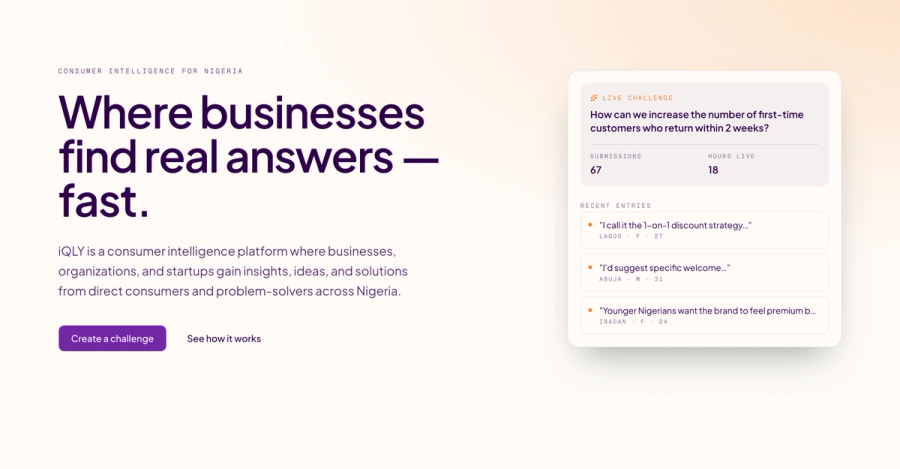
- Consumer Feedback Challenges: Another approach involves presenting a clearly defined business question to a group of contributors and inviting them to provide structured feedback, ideas, or solutions. This approach can be particularly useful when businesses want to explore different consumer perspectives or generate creative suggestions.
Platforms such as iQLY are designed to make this kind of engagement more accessible. The key is choosing a method that fits your research objective rather than assuming one approach works for every business problem.
Create your iQLY Challenge
Look Beyond Complaints and Discover Opportunities
Many businesses collect customer feedback primarily when something goes wrong.
A customer complains about delivery.
Another reports poor service.
Someone leaves a negative review.
The business responds, resolves the complaint, and moves on.
But customer feedback can do much more than identify problems.
It can reveal opportunities for innovation.
Imagine a Nigerian food delivery business asking consumers:
“What is one thing food delivery platforms could introduce that would significantly improve your experience?”
Some participants might suggest better delivery tracking.
Others might propose more flexible payment options, improved packaging, or features that make group orders easier.
Not every suggestion will be commercially practical.
However, recurring themes can help businesses identify opportunities worth investigating.
Your customers don’t just experience your products. They experience the problems your products are supposed to solve.
That perspective can be extremely valuable.
Consider Rewarding People for Their Time and Insights
One challenge businesses face when conducting research is getting people to participate.
Consumers are busy, and completing a detailed questionnaire or evaluating a product requires time and effort.
Offering appropriate incentives can encourage participation.
Depending on the research activity, incentives might include:
- Cash rewards.
- Shopping vouchers.
- Product samples.
- Discounts.
- Access to relevant experiences.
However, incentives should reward genuine participation, not pressure people into giving positive feedback.
If participants believe they must praise a business to receive a reward, the research may become less reliable.
Businesses should communicate eligibility requirements clearly and encourage honest responses, including criticism.
A well-designed incentive structure can help attract contributors while protecting the integrity of the feedback collected.
Turn Customer Feedback Into Actionable Business Decisions
Collecting responses is only the beginning.
The real value of customer research comes from understanding the information and applying it.
Suppose you operate an online fashion store and collect feedback from 100 consumers.
You discover that:
- Many respondents are concerned about product quality.
- Some struggle to determine the correct clothing sizes.
- Others are discouraged by delivery uncertainty.
- Several want more detailed product photographs.
Rather than treating every response as an isolated opinion, you can begin identifying recurring themes.
You might decide to improve your size guides, introduce clearer delivery information, or provide more detailed product descriptions.
These changes should then be tested to determine whether they improve customer satisfaction or purchasing behaviour.
It’s also important to remember that 100 responses do not automatically represent an entire market. The reliability of your findings depends on factors such as participant selection, question design, and research objectives.
Nevertheless, carefully collected feedback can provide a useful foundation for making decisions.
The best customer insights are not necessarily the most surprising. They’re the ones that help you take meaningful action.
How iQLY Helps Businesses Access Consumer Insights
For businesses that want to hear from consumers but lack the resources to organise extensive research activities independently, structured crowdsourcing offers another option.
iQLY is a platform connecting businesses with individuals who can contribute ideas, feedback, insights, and solutions to real business challenges.
Rather than relying exclusively on internal assumptions, businesses can create challenges around specific questions they want consumers to address.
For example, a business could ask:
A fintech startup: “What factors would make you trust a new digital payment platform?”
A fashion brand: “What would improve your experience when shopping for clothes online?”
A food business: “What new product or service would make you choose our brand more frequently?”
A technology startup: “What improvements would make our website easier and more enjoyable to use?”
Contributors can respond to these challenges by sharing their experiences, opinions, and ideas. Depending on the challenge structure, eligible submissions may also have opportunities to receive rewards.
For businesses, this creates an avenue to explore consumer perspectives, identify recurring concerns, and discover ideas worth investigating further.
iQLY’s challenge-based approach is particularly suited to businesses seeking exploratory insights, creative solutions, and structured consumer feedback.
For research requiring statistically representative findings, specialised sampling or additional research methods may still be necessary.
Start Small, Learn Quickly, and Improve Continuously
You don’t need to conduct a nationwide survey before making your first customer-informed decision.
Start by identifying one important question your business needs answered.
Perhaps you’re struggling with customer retention.
Maybe you’re considering introducing a new product.
Or perhaps your customers aren’t responding to your marketing campaigns as expected.
Whatever the problem, begin with a clear research objective.
Identify the people whose opinions matter.
Ask thoughtful questions.
Collect feedback.
Analyse the responses.
Then use what you’ve learned to make and test improvements.
As your business grows, you can expand your research efforts and develop more sophisticated ways of understanding your market.
The important thing is to build a culture where customer insights influence business decisions.
Final Thoughts: Stop Guessing. Start Listening.
Nigeria is home to consumers with diverse needs, preferences, expectations, and experiences.
For businesses operating in such a dynamic environment, understanding customers is not a luxury reserved for large corporations.
It’s an important part of building products and services that people genuinely value.
You don’t need millions of naira to begin listening.
You need the right questions, the right participants, and a willingness to learn from what they tell you.
And sometimes, the idea that helps your business grow could come from someone you would never have thought to ask.
Ready to Discover What Consumers Really Think?
Your next product improvement, marketing insight, or innovative business idea could begin with a simple question.
With iQLY, you can invite consumers to share their perspectives, contribute ideas, and help you explore real business challenges.
Whether you’re validating an idea, improving an existing product, or searching for fresh perspectives, iQLY provides a platform for connecting your business with contributors.
Stop guessing what your customers want. Start asking.